
Last updated: September 9, 2026
You have forty-five minutes between a 7am call and a board deck that needs finishing. A hotel gym with two treadmills and a rack of ten-kilo dumbbells is not going to build the physique or the resilience you need. This is exactly why resistance band exercises for professionals have become the default training method for people who travel constantly, work long hours, and refuse to let their body pay the price for their career. Bands roll into a laptop bag, set up in ninety seconds, and deliver the same mechanical tension as a cable stack, without the postal code requirement.
This guide is built for the working professional who trains around a calendar, not the other way around. You will get exercise breakdowns for every major muscle group, ready-made circuits for 12, 20, and 30 minutes, desk-break routines, hotel-room programming, and the mistakes that quietly stall progress. Everything here assumes one thing: you want results, and you do not have time to waste on guesswork.
Professionals do not fail at fitness because they lack motivation. They fail because their training method assumes a life they do not have, fixed gym hours, a permanent location, unlimited free time. Resistance bands remove every one of those assumptions.
A commute to a commercial gym, changing, warming up on a machine queue, and showering again easily eats 90 minutes for a 30-minute workout. A resistance band session starts the second you unroll the band. There is no queue for a squat pattern. This alone is why so many senior executives and consultants have quietly switched to band-based training as their primary method, not a backup plan.
Home training used to mean a spare room and a rack of dumbbells nobody’s landlord was thrilled about. A full set of resistance bands fits inside a shoebox and delivers a loading range from light rehab work to heavy strength training, all from a corner of a living room, a hotel balcony, or an office break room.
This is where bands separate themselves from every other training tool. Dumbbells do not go through airport security checks gracefully. Bands weigh under 300 grams for a full set and pack flat. For anyone who lives out of a suitcase eight or ten times a month, resistance band exercises for professionals are not a compromise, they are the only training method that travels as often as you do.
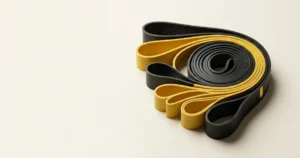
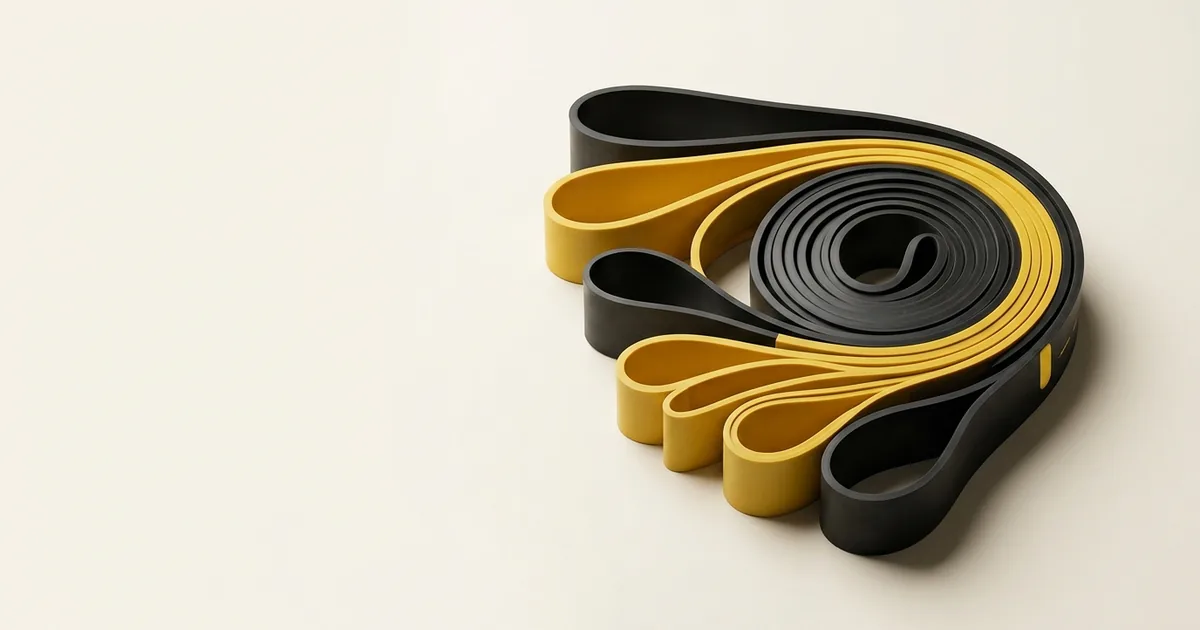
Not all bands do the same job. A serious professional training setup uses a mix of formats, not a single band.
Small continuous loops, typically placed around the ankles, knees, or wrists. Best for glute activation, lateral hip work, and warm-up sequences before heavier lifting. Light in nature but brutally effective for waking up muscles that desk work switches off, especially the glutes.
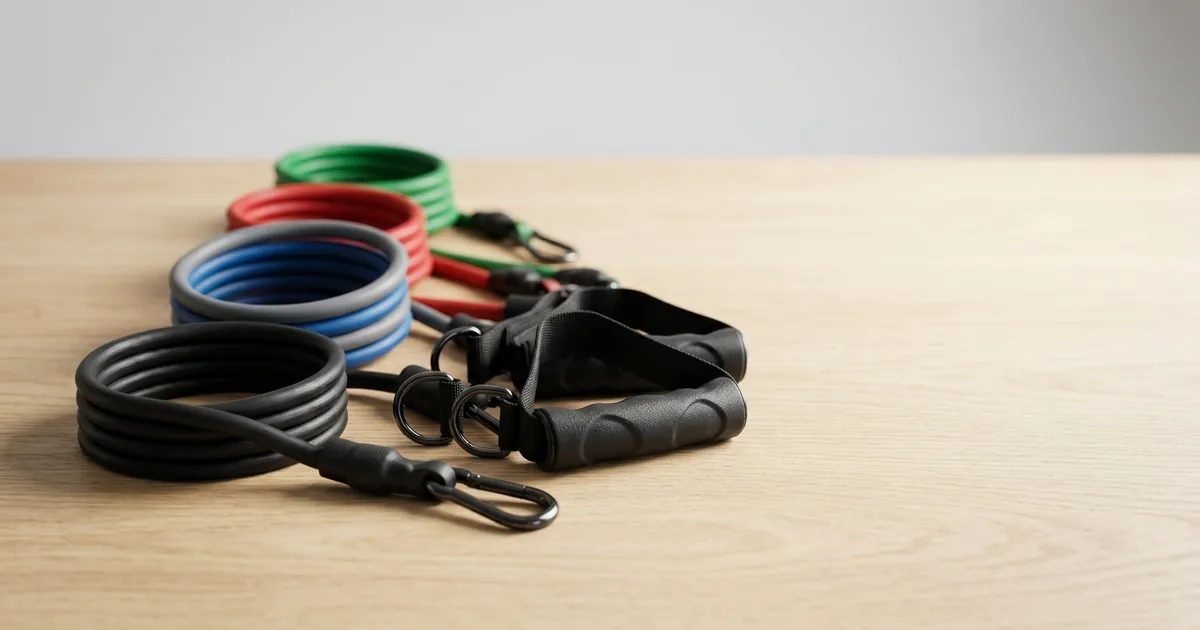
These mimic cable machine movements almost exactly, rows, presses, curls, pull-aparts. The handles allow a firm grip under heavier tension, making them the closest thing to a portable cable station. Anyone missing their gym’s cable machine while traveling should default to tube bands first.
A short, fixed-length band shaped like a figure eight, ideal for isolated upper body work in tight spaces, hotel rooms, airport lounges, even under a desk. Limited range compared to loop or tube bands, but unmatched for discretion and control.
Wide, flat, and usually the lightest resistance option. These are the go-to for shoulder prehab, rotator cuff work, and mobility drills, exactly the kind of maintenance work professionals skip until an injury forces them to pay attention.
Color-coded resistance (light, medium, heavy, extra-heavy) is standard across most band brands. A professional’s kit should include at minimum a light and a heavy option per format. Buying a single resistance level is the single most common reason people abandon band training within a month, they hit a plateau because they have no way to progress the load.
Eight to ten hours in a chair shortens the hip flexors, rounds the thoracic spine, and switches off the glutes. Skipping a warm-up under these conditions is how professionals hurt themselves during ordinary squats. This sequence takes four minutes.
These movements cover chest, back, shoulders, and arms with the same pressing, pulling, and rotational patterns you would find on a cable stack.
Anchor the band behind you at chest height, or step on it if using a tube band without an anchor. Press both handles forward until arms are extended, control the return. 3 sets of 12-15. Builds pressing strength without loading the shoulder joint the way a bench press can.
Step on the band with a hip hinge position, pull both handles to the ribs, squeeze the shoulder blades together. 3 sets of 12-15. This is the single most important exercise for professionals who sit all day, it directly counters the forward-shoulder posture that desk work creates.
Step on the band, press handles overhead from shoulder height. 3 sets of 10-12. Keep the ribs down and avoid arching the lower back.
Step on the band’s center, raise both arms out to shoulder height. 3 sets of 15. Light resistance is enough here, this movement is about shoulder shape and joint health, not maximal load.
Step on the band, curl handles up while keeping elbows pinned to the sides. 3 sets of 12-15.
Anchor the band low behind you, extend arms overhead. 3 sets of 12-15.
Anchor at chest height, pull the band toward the face with elbows high. 3 sets of 15. This is the single best exercise for reversing rounded shoulders and should sit in every professional’s weekly program without exception.
Bands are frequently underrated for lower body training, but with the right anchor points they load the glutes, hamstrings, and quads effectively enough to build real strength.
Step on the band with feet shoulder-width, hold handles at shoulder height, squat down and drive up. 4 sets of 12-15. Constant tension through the entire range makes this harder than it looks on a heavy loop band.
Place a loop band above the knees, lie on your back, drive hips upward while pressing knees outward against the band. 3 sets of 15-20. This single change, adding lateral band tension, turns a basic bridge into serious glute work.
Loop band above the ankles or knees, half-squat stance, step sideways maintaining tension. 3 sets of 10 steps each way. Essential for hip stability, especially for professionals who run or play sport on weekends without proper lateral conditioning during the week.
Step on the band, hinge at the hips keeping a flat back, stand tall by driving through the heels. 3 sets of 12. Trains the entire posterior chain, the muscle group most neglected by desk-bound professionals.
Step on the band, rise onto the toes against resistance. 3 sets of 20.
Loop band above the knees, lie on your side, open and close the top knee. 3 sets of 15-20 per side. A staple in physiotherapy programs for a reason, it targets the glute medius directly.
Core strength for a professional is not about visible abs, it is about a spine that can handle eight hours of sitting followed by a heavy squat without complaint. Bands are exceptional at anti-rotation training, a category most gym-goers ignore entirely.
Anchor the band at chest height to your side, hold the handle at your chest, press straight out and resist the band’s pull to rotate you. 3 sets of 12 per side. This is the gold standard core exercise for anyone who wants a strong, stable spine without spinal flexion.
Anchor low, pull the band diagonally across the body to overhead, rotating through the torso. 3 sets of 12 per side. Builds rotational power relevant to golf, tennis, and everyday twisting movements.
In a plank position with the band anchored in front, row one handle back while keeping hips square. 3 sets of 10 per side. Combines core anti-rotation with a back exercise, efficient for time-poor training.
Structure beats intensity when time is the constraint. Below are three ready-made sessions.
| Exercise | Duration |
|---|---|
| Banded squat | 45 sec on / 15 sec off |
| Standing chest press | 45 sec on / 15 sec off |
| Bent-over row | 45 sec on / 15 sec off |
| Glute bridge | 45 sec on / 15 sec off |
| Pallof press (each side) | 45 sec on / 15 sec off |
Repeat the circuit twice. This is the exact routine to run before an early meeting when a full session is impossible but skipping training entirely is not acceptable.
4 rounds of: banded squat x15, bent-over row x15, shoulder press x12, glute bridge x20, face pull x15. Rest 60 seconds between rounds. This is a legitimate strength session, not a warm-up, expect real muscular fatigue by round three.
Warm-up (4 minutes) followed by upper body block (chest press, row, shoulder press, face pull, 3 sets each), lower body block (squat, deadlift, lateral walk, 3 sets each), and a core finisher (Pallof press, woodchopper, 2 sets each). This is the session to run three to four times weekly for genuine strength and conditioning progress.
You do not need a full session to counteract eight hours of sitting. A figure-8 band kept in a desk drawer allows a two-minute reset between calls: 15 band pull-aparts, 15 seated leg extensions against the band, and 10 shoulder dislocates. Done twice a day, this alone noticeably reduces the shoulder and lower back tightness that builds up during long work stretches. Keep a microfiber workout towel at the desk too, a quick wipe-down after a movement break keeps things professional if you are stepping straight back into meetings.
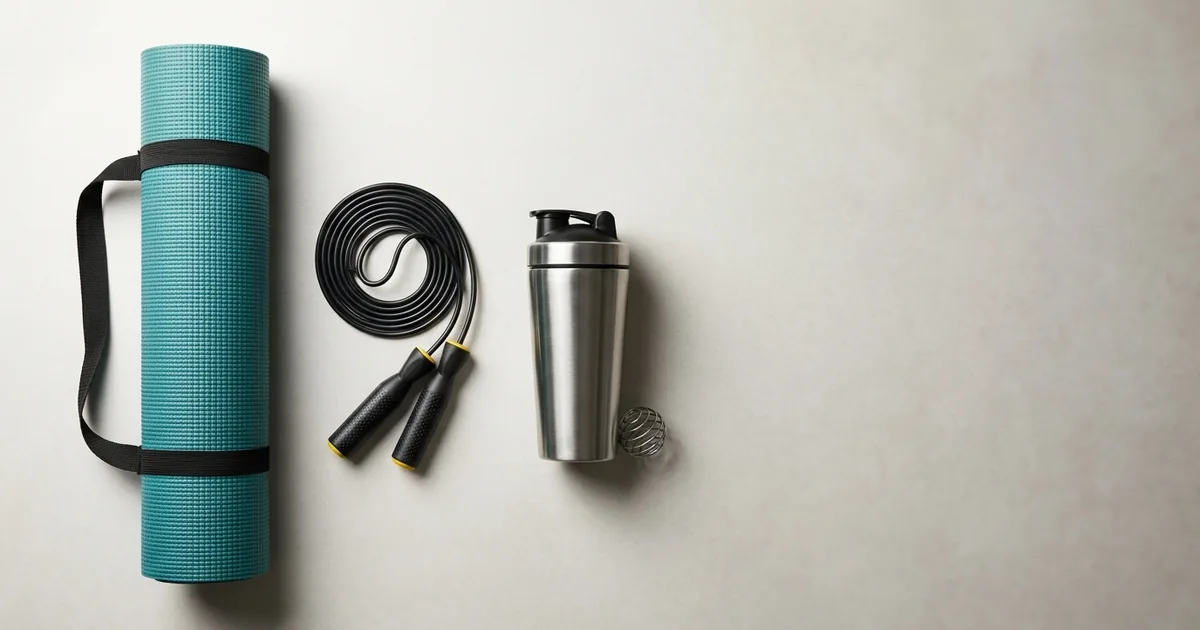
Pack a set of loop bands and a tube band with handles, nothing else is required. A hotel routine should hit every major muscle group in under 25 minutes: banded squats, chest press, bent-over row, glute bridges, lateral walks, and a Pallof press finisher. Anchor points are usually available on a door hinge or a heavy piece of furniture. For cardio on the same trip, a compact, tangle-free jump rope solves the conditioning side without needing outdoor space or a treadmill, check the adjustable beaded jump rope if you want something that packs as easily as the bands themselves.
Bands are the foundation, but pairing them with a small amount of other portable gear multiplies what a home or travel setup can do.
A short session on a vibration platform before a band workout activates the muscles faster and can reduce the stiffness that builds up from long flights or long meetings. Five minutes standing on the platform before your warm-up band sequence noticeably improves the quality of the following session.
As resistance increases on rows, deadlifts, and pull patterns, grip becomes the limiting factor before the target muscle is fully worked. A pair of gym gloves or lifting straps solves this, letting the back and legs do the work instead of the forearms giving out first. Browse the gym gloves and straps range if band handles are slipping during heavier sets.
A dedicated microfiber workout towel is a small detail that matters more than it seems for professionals training between meetings or in shared hotel gyms, quick-drying and compact enough to throw in a bag without adding bulk.
If you are assembling a complete travel or home setup for the first time, check the new arrivals category regularly, band sets, portable gear, and accessories built for exactly this training style are added on an ongoing basis.
The biggest myth around band training is that it cannot build real strength. The truth is bands progress differently than dumbbells, and professionals need to understand the mechanism to keep improving.
Moving from a medium band to a heavy band is the most direct form of progression, equivalent to adding weight plates.
Bands get harder the further they stretch. Starting a movement from a longer starting position increases the tension throughout, even with the same band.
A 3-second eccentric on a banded squat or row dramatically increases time under tension without needing a heavier band, useful when you have hit the top resistance level in your kit.
A 2-second pause at peak contraction on rows, presses, or bridges increases difficulty and improves mind-muscle connection, a detail that matters when a full gym session is not always possible.
Even without weights on a bar, tracking sets, reps, and resistance level week to week keeps the program accountable. Professionals who log this consistently see far better long-term results than those who “just do bands” without structure.
Progress stalls fast when every set uses the same band. Buy a range from the start.
A band that slips off a door hinge mid-row is a fast way to get hurt. Always test the anchor with light tension before loading the movement fully.
Bands lose almost all their benefit when reps are rushed, since the tension curve is what makes them effective. Control both directions of every rep.
Professionals sitting for long stretches are more injury-prone, not less, when jumping straight into loaded movement. The four-minute warm-up above is non-negotiable, not optional.
Bands and free weights load muscles differently, bands increase tension through the range while weights are heaviest at specific joint angles. Neither is superior, they are complementary. Dismissing bands as a “lesser” tool means missing out on a training stimulus that weights alone cannot replicate.
Resistance bands are used in physiotherapy clinics worldwide for a reason, they allow controlled, low-impact loading exactly where movement needs to be restored. For professionals, this makes bands the ideal tool for shoulder health (given how much time is spent typing and looking down at phones), hip mobility (given how much time is spent seated), and general joint resilience. A five-minute band mobility routine before bed, focused on shoulder dislocates, hip circles, and ankle flexion against light band tension, is a simple habit that reduces the stiffness professionals often mistake for “just getting older.”
A professional-grade band kit should include loop bands in at least two resistance levels, a tube band set with interchangeable handles and a door anchor, and one flat therapy band for mobility and prehab work. Look for bands made from layered latex or fabric-wrapped resistance material, these last significantly longer under repeated travel and heavy use than cheap single-layer rubber. Pricing across a full kit typically runs in the AED 100-300 range depending on quality and included accessories, a small investment relative to a single month of a commercial gym membership.
Resistance band exercises for professionals are not a workaround for people too busy to train properly, they are a complete training system built for a life that moves between offices, airports, and hotel rooms. With the right band selection, a structured warm-up, and programming that actually progresses week over week, a career-focused professional can build real strength, protect their joints from the damage of a sedentary job, and never again use “no gym access” as a reason to skip training. Pack the bands, set the timer, and get the work done, wherever the day takes you.
Yes. With progressive overload principles applied, higher resistance levels, slower tempo, paused reps, and increased range of motion, bands create enough mechanical tension to build genuine strength and muscle, not just maintain fitness levels.
A minimal but complete kit is two loop bands of different resistance, one tube band with handles and a door anchor, and one flat therapy band. This covers upper body, lower body, and mobility work in a package that fits in a laptop bag.
Three to four full sessions of 20-30 minutes, supplemented by short 2-minute desk-break resets, is enough to build strength and counter the effects of long sitting hours. Consistency across the week matters more than session length.
For most professionals, yes. Bands cover strength training for every major muscle group. Pairing them with a portable jump rope for cardio and a vibration platform for recovery when available at home creates a complete training system without needing a commercial gym.
Buying only one resistance level. Progress stalls quickly without the ability to increase load, so a starting kit should always include at least two resistance levels per band format.

آخر تحديث: 9 سبتمبر 2026 إذا كنت تبحث عن ادوات التمارين الرياضية في المنزل التي تجعل التمرين اليومي أسهل بدون
Last updated: September 9, 2026 A walking pad solves a very specific problem: you want daily cardio without giving up
Last updated: September 6, 2026 A resistance band weighs less than a phone charger, fits in a laptop bag, and