
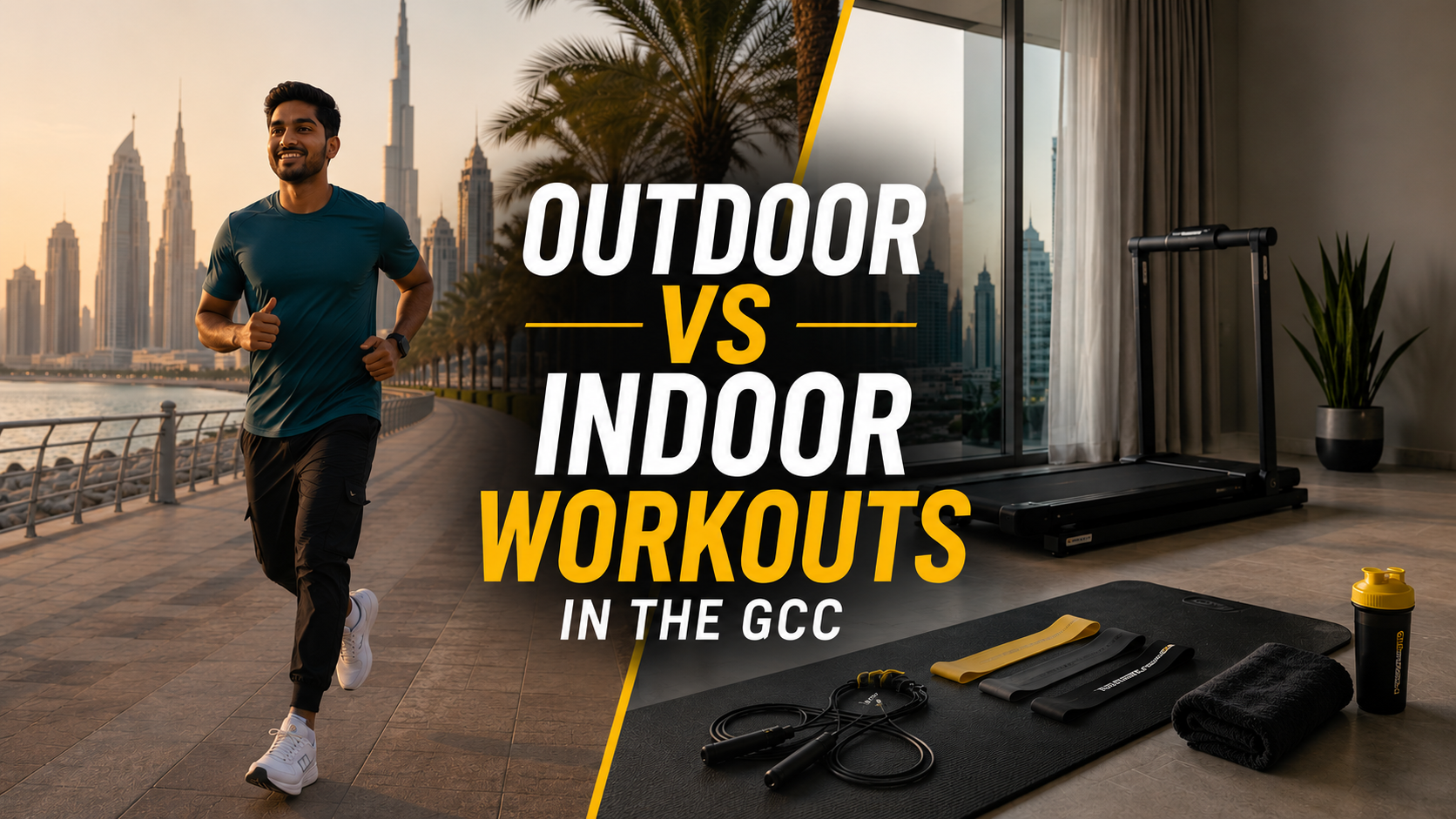
Outdoor vs indoor workouts in the GCC is not just a fitness preference; it’s a smart decision that affects your safety, consistency, comfort, and long-term results. If you live in the UAE, Saudi Arabia, Kuwait, Qatar, Bahrain, or Oman, you already know that the weather can change the way you train. A workout that feels amazing in December can feel exhausting, unsafe, or impossible in July.
Many fitness enthusiasts love outdoor workouts because they offer fresh air, open space, sunlight, and a change of scenery. At the same time, indoor workouts provide air conditioning, privacy, consistency, and easy access to fitness equipment. So, which one is better?
The answer depends on your goal, the season, the time of day, and how your body handles heat. In this blog, we’ll break down the benefits of both outdoor and indoor workouts, the challenges of training in GCC weather, and how to build a balanced routine that keeps you active all year.
In many countries, choosing between indoor and outdoor exercise is mostly about personal preference. In the GCC, it’s also about climate.
The region is known for hot summers, strong sun exposure, high humidity in some areas, and long periods where midday outdoor activity can feel extremely challenging. That doesn’t mean outdoor workouts are bad. It simply means they need to be planned carefully.
A morning walk by the beach, an evening run, or a winter park workout can feel refreshing and motivating. But during peak summer heat, an outdoor session can quickly lead to fatigue, dehydration, dizziness, or poor performance if you are not prepared.
This is why outdoor vs indoor workouts in the GCC should be viewed as a year-round strategy. You do not need to choose only one. You need to know when each option works best.
Outdoor workouts can be incredibly enjoyable when the weather is right. During cooler months, the GCC offers beautiful outdoor spaces for walking, running, cycling, beach training, and park workouts.
Training outside can also make exercise feel less repetitive. Instead of looking at the same wall or screen, you get movement, sunlight, scenery, and fresh air.
Outdoor workouts can help with:
For many people, outdoor training feels more natural. A simple walk after sunset or an early morning run can become an enjoyable habit rather than a strict workout.
One of the best parts of outdoor exercise is the mental reset. After spending hours indoors at work, in traffic, or at home, moving outside can feel refreshing.
Outdoor workouts allow you to disconnect from screens, breathe differently, and enjoy a change of environment. This can make fitness feel more enjoyable and less like a task.
For people who struggle with motivation, outdoor training during cooler weather can be a powerful tool. A beach walk, park jog, or outdoor bodyweight circuit can make movement feel simple and rewarding.
However, the key phrase is “during cooler weather.” In GCC summer, outdoor workouts need extra caution.
While outdoor workouts have many benefits, GCC weather can create real challenges. Heat and humidity can make your body work harder than usual. Even a workout that normally feels easy can become more intense when the temperature is high.
Outdoor workout challenges include:
In hot weather, your body uses more energy to cool itself. You may feel tired faster, lose fluids more quickly, and need longer recovery. That is why outdoor workouts during the hottest part of the day are usually not the smartest choice.
If you feel dizzy, weak, nauseous, unusually tired, or experience muscle cramps, stop immediately and move to a cooler place.
Indoor workouts are one of the most practical ways to stay consistent in the GCC. They allow you to train in a controlled environment, away from extreme heat and direct sun exposure.
Whether you train at home or in a gym, indoor workouts give you more control over temperature, timing, equipment, and intensity.
Indoor workouts are great for:
For busy people, indoor workouts are often easier to maintain. You don’t need to drive to a park, check the temperature, or wait for sunset. You can simply roll out a mat, grab your resistance bands, and start.
Consistency is one of the biggest factors in fitness progress. You can have the perfect outdoor running plan, but if the weather makes you skip half your sessions, results will slow down.
Indoor training removes many barriers. You can exercise in your living room, bedroom, office, or home gym corner. Even a 20-minute indoor workout can help you stay on track.
This is especially useful during UAE and GCC summer, when outdoor training may only be comfortable early in the morning or late in the evening.
Indoor workouts help you stay active even when:
This is where home fitness equipment becomes valuable.
During the cooler months, outdoor training can be enjoyable and effective. During peak GCC summer, indoor workouts are usually the safer and more consistent option.
Here is a simple comparison:
| Feature | Outdoor Workouts | Indoor Workouts |
|---|---|---|
| Summer safety | Riskier during peak heat | Safer in air conditioning |
| Consistency | Weather-dependent | Easier year-round |
| Motivation | Fresh air and scenery | Convenient and controlled |
| Equipment | Limited unless at outdoor gym | More flexible at home or gym |
| Best time | Early morning or evening | Any time |
| Best for | Walking, running, cycling, park workouts | Strength, cardio, mobility, recovery |
| Comfort | Depends on weather | Predictable environment |
| Hydration needs | Higher in heat | Easier to manage |
Clearly, indoor workouts have a major advantage during hot months. But outdoor workouts still have their place when the timing and weather are right.
When the weather is pleasant, outdoor training can be one of the best ways to enjoy fitness.
Great outdoor workouts include:
Walking is simple, low-impact, and suitable for most fitness levels. It is ideal for beginners, weight-loss goals, and active recovery days.
Running outdoors can improve endurance and mental toughness. Choose safe paths, avoid peak heat, and build distance gradually.
Cycling is a great cardio option during cooler months. It can be done on dedicated tracks, parks, or safe cycling routes.
You can train with squats, lunges, push-ups, planks, step-ups, and mobility exercises in a park or outdoor space.
Beach workouts can be fun and challenging. Sand adds resistance, but it can also make movements harder, so start slow.
Parks are perfect for family-friendly movement, walking, stretching, and bodyweight training.
Stretching outdoors during cooler weather can be relaxing and refreshing, especially in the morning or evening.
When the heat becomes too intense, indoor workouts help you stay active without skipping your routine.
Great indoor workout options include:
Resistance bands are compact, affordable, and ideal for full-body strength training at home. You can train your legs, glutes, back, chest, shoulders, arms, and core without bulky equipment.
A mini treadmill or walking pad is excellent for indoor steps, low-impact cardio, and staying active while working from home.
A skipping rope is a small but powerful cardio tool. Use it in short intervals if you have enough space and suitable flooring.
If you have dumbbells, you can build a simple strength routine for squats, presses, rows, lunges, and core movements.
Yoga and stretching help improve mobility, flexibility, breathing, and recovery. A good exercise mat makes the session more comfortable.
Planks, dead bugs, mountain climbers, crunch variations, and leg raises can all be done indoors with minimal equipment.
Recovery tools, stretching, and light movement help your body feel better between harder workouts.
The best choice depends on your goal and environment.
| Goal | Better Option |
|---|---|
| Weight loss consistency | Indoor workouts |
| Mental refreshment | Outdoor workouts in cooler hours |
| Summer safety | Indoor workouts |
| Running performance | Mix of indoor and outdoor |
| Strength training | Indoor or home gym |
| Small apartment fitness | Indoor compact equipment |
| Weekend variety | Outdoor workouts |
| Recovery and mobility | Both indoor and outdoor |
| Busy work schedule | Indoor workouts |
| Family activity | Outdoor walks or indoor movement |
If your goal is consistency, indoor workouts are often easier. If your goal is enjoyment and variety, outdoor workouts are excellent when the weather allows.
Outdoor exercise can be safe and enjoyable if planned properly. The problem is not outdoor training itself; the problem is ignoring heat, hydration, and timing.
Use these safety tips:
Your body gives warning signs when it is struggling. Listen to them.
Hydration matters in every workout, but it matters even more in GCC weather. High heat and sweating can lead to fluid loss quickly.
Keep a water bottle or shaker nearby, especially during outdoor workouts. If your session is long or very sweaty, consider electrolytes as well.
Signs you may need more fluids include:
A simple habit like carrying a bottle can make your workouts safer and more comfortable.
A strong indoor routine does not require a full gym. With a few compact tools, you can train effectively at home.
Useful indoor fitness equipment includes:
Perfect for strength training, mobility, warm-ups, and full-body workouts.
Essential for stretching, core training, yoga, Pilates, and floor exercises.
Great for quick cardio workouts and conditioning.
Useful for walking indoors, increasing steps, and staying active during summer.
Support hydration and nutrition before, during, and after workouts.
Help improve grip and comfort during strength training.
Keep you dry, comfortable, and focused during sweaty indoor or outdoor sessions.
Useful for recovery, relaxation, and post-workout care.
These tools make indoor training easier, especially when the weather outside is not ideal.
The smartest approach is not choosing one forever. The best strategy is to combine both.
Use outdoor workouts when the weather is cool and enjoyable. Use indoor workouts when it is too hot, humid, dusty, or inconvenient to train outside.
A balanced weekly plan could look like this:
| Day | Workout |
|---|---|
| Monday | Indoor resistance band workout |
| Tuesday | Outdoor evening walk |
| Wednesday | Indoor treadmill or skipping rope |
| Thursday | Yoga and mobility at home |
| Friday | Strength workout indoors |
| Saturday | Outdoor cycling or park workout |
| Sunday | Recovery, stretching, or light walk |
This kind of routine gives you the best of both worlds: consistency from indoor training and variety from outdoor movement.
Let’s make it simple.
Outdoor workouts are best when:
Indoor workouts are best when:
For most people in the GCC, indoor training should be the foundation during summer, while outdoor workouts can be added during cooler months or cooler times of day.
Outdoor workouts can be risky during peak summer heat, especially at midday. If you train outdoors, choose early morning or evening, reduce intensity, hydrate well, and stop if you feel dizzy, weak, or overheated.
Indoor training is often better during hot UAE summer months because it offers air conditioning, consistency, and safer conditions. Outdoor training is still useful during cooler months or cooler hours.
The best times are usually early morning or after sunset, when temperatures are lower and sun exposure is reduced.
Yes. Indoor workouts can support weight loss when done consistently with proper nutrition. Resistance bands, skipping ropes, mini treadmills, and bodyweight circuits can all help you stay active indoors.
Start with simple tools like resistance bands, an exercise mat, skipping rope, water bottle, sweat towel, and optional mini treadmill or recovery tools.
Outdoor workouts can feel refreshing and motivating because they provide scenery, sunlight, and fresh air. However, indoor workouts may be better when outdoor conditions are too hot or uncomfortable.
During peak GCC summer, a treadmill or walking pad can be a safer and more consistent alternative to outdoor running. You can return to outdoor runs when the weather is cooler.
Outdoor vs indoor workouts in the GCC is not about which option is always better. It is about choosing the right workout environment for the season, weather, safety, and your fitness goals.
Outdoor workouts can be refreshing, motivating, and enjoyable during cooler months. Indoor workouts are practical, safe, and consistent during hot summer days.
If you want long-term results, build a routine that uses both. Train indoors when the weather is harsh, go outdoors when conditions are comfortable, and keep compact fitness equipment ready at home so you never have to skip a workout.
Fitness in the GCC is all about smart planning. Choose the environment that helps you stay safe, stay consistent, and keep moving.
Best time to exercise in UAE is one of the most important questions for anyone who wants to stay fit,

دليل شراء معدات رياضية منزلية هو الخطوة الأولى لكل شخص يريد بدء التمرين في البيت بطريقة صحيحة بدون إهدار المال

Full body resistance band workout routines are one of the easiest ways to build strength at home without bulky gym